


A standard operating procedure (SOP) is a written set of instructions for doing a routine task correctly and consistently. It records the agreed way to do the job, in steps, so that anyone trained on it gets the same result, whether it’s their first week or their tenth year.
The US Environmental Protection Agency’s guidance on writing procedures gives one of the clearest definitions: an SOP is “a set of written instructions that document a routine or repetitive activity followed by an organization.” Each word in the name does some work:
Examples are everywhere once you look: how a café closes the till, how a dental practice sterilises instruments, how an ecommerce shop handles a return, how an electrician isolates a circuit before working on it, how an accountant reconciles a bank account at month end. Each is a routine task where getting it wrong costs money, time, customers or safety.
SOP stands for standard operating procedure. You’ll also see “standing operating procedure”, mostly in military use, and the plural “standard operating procedures”. Businesses call SOPs many things: procedures, protocols, work instructions, method statements, playbooks or simply “how we do it”. The name matters less than what’s in it.
Consistency. Customers get the same result whoever serves them. Without a standard, quality depends on who’s on shift.
Training. A new starter learns from the SOP rather than from whoever has time to show them, which usually means picking up that person’s shortcuts and gaps. Training from SOPs is faster and the same for everyone.
Fewer mistakes. Writing a procedure down forces you to decide the right way, including the exceptions. “What if there’s no receipt?” gets answered once, not every time it comes up.
Delegation. You can’t hand over work that only exists in your head. An SOP is what lets an owner or a senior person delegate for good, and it’s the cure for key-person dependency.
Compliance and safety. In regulated work, written procedures are often required, and they’re the first thing an auditor or inspector asks to see.
Improvement. You can only improve a process that’s written down. Once it’s an SOP, a better way can be tested, agreed and rolled out to everyone at once.
A more valuable business. Buyers pay more for a business that runs without its owner. Documented procedures are the evidence. Our guide to systemising your business shows how SOPs fit into the bigger picture.
Not every task needs an SOP. Writing them for everything wastes time and buries the important ones. Write an SOP when a task is:
| Write an SOP when the task is… | Because… | Example |
|---|---|---|
| Done often | Small differences add up across hundreds of repeats | Taking a booking, packing an order |
| Done rarely, but must be right | Nobody remembers the steps from one year to the next | Year-end stocktake, renewing a licence |
| Risky | A mistake could hurt someone or cost a lot | Isolating power, handling chemicals, giving medication |
| Regulated | The law or a standard expects a written procedure | Food safety, infection control, client identification |
| Done by several people | Each person will otherwise invent their own way | Opening and closing, cash handling |
| Known by only one person | Their absence or resignation would stop the work | Payroll, supplier ordering, the month-end close |
You usually don’t need an SOP for one-off projects, work that is mostly judgement (such as handling an angry customer, where principles and examples help more than steps), or tasks so simple that a one-line checklist item covers them.
Most SOPs share the same structure. For a small business, these parts cover it:
| Part | What it covers | Example: cash handling |
|---|---|---|
| Header and document control | Title, ID, version, owner, approval date and next review date | “Cash handling procedure, v3, owner: operations manager, review: June” |
| Purpose | Why the procedure exists, in a sentence or two | “So every dollar taken is counted, recorded and banked” |
| Scope | Where it applies and where it doesn’t | “All tills, all shifts; not online payments” |
| Roles and responsibilities | Who does what | Cashier, shift manager, owner |
| Definitions | Terms a new starter might not know | Float, safe drop, void |
| Equipment and materials | What’s needed before starting | Count sheet, safe, deposit book |
| Steps | Numbered, in order, each starting with a verb | “1. Issue and check the float. 2. Take payments correctly…” |
| Cautions | Safety warnings and the mistakes to avoid, next to the step they apply to | “Never count cash where customers can see it” |
| Records | What gets written down or kept as evidence | The count sheet and deposit slip |
| Related documents | Linked policies, forms, SOPs and process maps | Refund procedure, till limit policy |
| Revision history | What changed, when and who approved it | “v3: added safe drop limit” |
The free SOP template has all of these sections, ready to fill in, and our guide to SOP templates for 10 industries shows how they vary by sector.
The EPA’s guidance describes three main ways to write the steps of an SOP. Modern tools have added a few more.
| Format | What it looks like | Best for |
|---|---|---|
| Simple steps | A short numbered list | Short, routine procedures with few decisions, such as opening the shop |
| Hierarchical steps | Numbered steps with sub-steps (1, 1.1, 1.2) | Longer procedures where some steps need detail, such as a month-end close |
| Flowchart | A diagram of steps and decisions | Procedures with many decisions or several people, such as approving a refund |
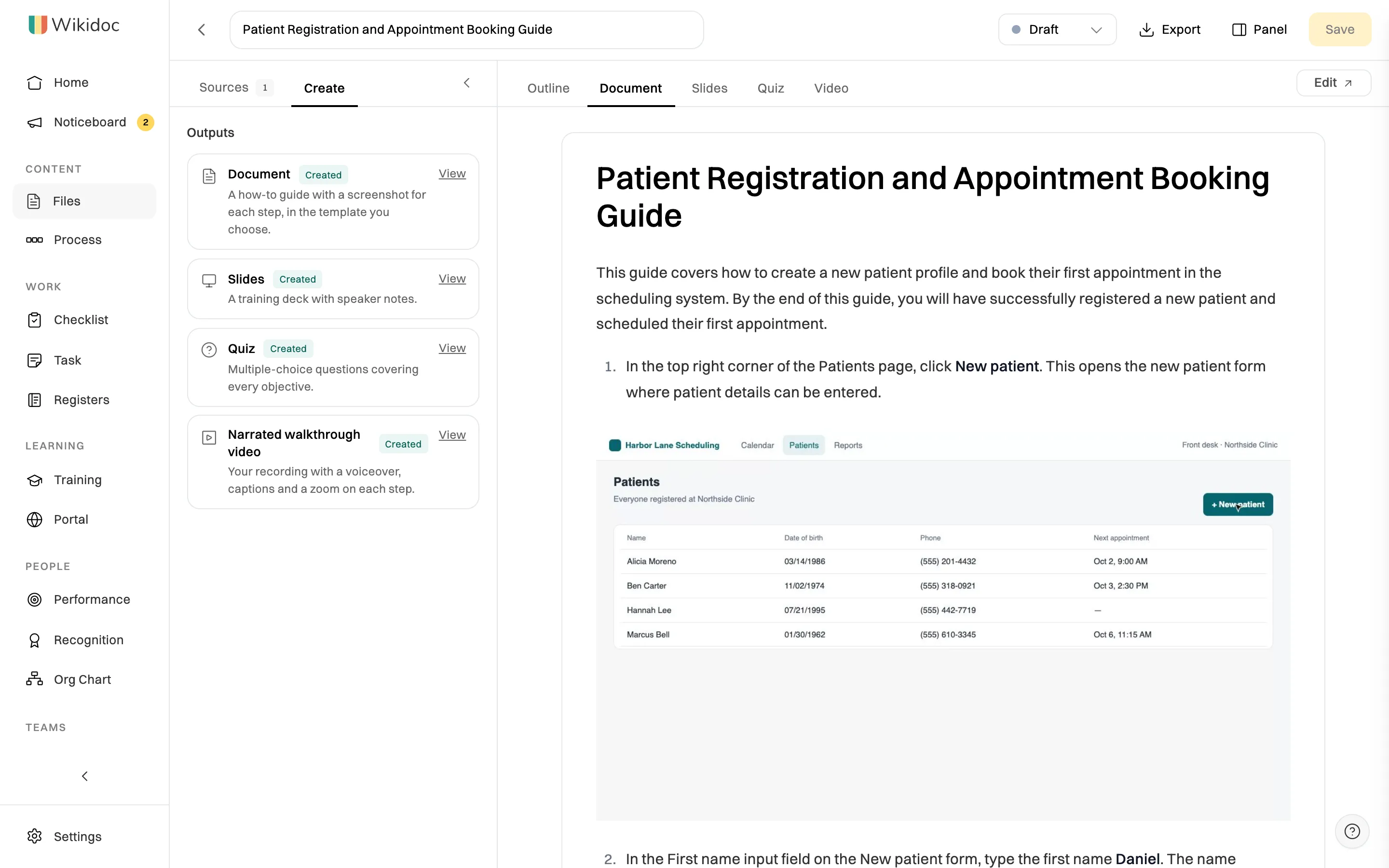
| Screenshot or photo SOP | A picture beside each step | Software tasks and physical tasks where “what it looks like” matters |
| Video SOP | A narrated recording of the task | Hands-on skills that are hard to describe in words |
| Checklist | A list of the critical steps to tick off | Confirming a known procedure was done, alongside the full SOP |
You don’t have to pick one. Many good SOPs combine them: numbered steps with a screenshot for each, a flowchart for the tricky decision, and a short video for the hands-on part. Where a procedure branches a lot or crosses several people, start with a process map and write SOPs for the steps that need them.
Here are three short SOPs from different kinds of business. Each is condensed; the linked templates have the full versions with roles, records and cautions.
Purpose: to make sure every dollar taken is counted, recorded and banked. Scope: all tills and all shifts. Owner: the operations manager.
Caution: never count or move cash where customers can see it. Records: count sheet, deposit slip. Get the full cash handling procedure.
Purpose: to decide every return the same way, and refund customers quickly. Scope: online orders. Owner: the customer service lead.
Because this procedure is mostly decisions, it pairs well with a map: see the returns and refunds procedure and the refund eligibility flowchart.
Purpose: to stop equipment being energised while someone works on it. Scope: any work on electrical, mechanical, pressurised or stored-energy equipment. Owner: the site supervisor.
This is a READ-DO procedure: the steps are done in order, every time, because a missed step can kill. See the full lockout/tagout procedure.
These documents are often confused, but each answers a different question:
| Document | Answers | Example |
|---|---|---|
| Policy | What do we do, and why? The rule or commitment | “Refunds are given within 30 days with proof of purchase” |
| Process | What happens, from start to finish, and who’s involved? | The refund process across customer service, warehouse and manager |
| Process map | The process drawn as a diagram | A swimlane map of the refund process |
| SOP | How do I do this procedure, step by step? | “How to process a refund” |
| Work instruction | How do I do this one task, in fine detail? | “How to issue a refund in Shopify” |
| Checklist | Did we do every critical step? | The end-of-day refunds and cash-up check |
A useful way to remember it: the policy sets the rule, the process map shows the journey, the SOP explains each procedure, and the checklist confirms it was done. Our comparison of SOPs, work instructions and process maps goes deeper, and what is a checklist explains how checklists and SOPs work together.
For many businesses SOPs are good practice. In some industries, they’re expected or required:
Rules differ by country and change over time, so check what applies where you work. Our ultimate guide to SOPs covers regulated industries in more detail.
Most SOPs never get written because writing takes too long. Recording the task once and letting AI draft the SOP removes that obstacle. See how to create SOPs with AI, or try the free AI SOP generator.
| Sign | What it usually means |
|---|---|
| People still ask the same questions | The SOP is missing the answer, or nobody can find it |
| Experienced staff do it differently from the SOP | The SOP is out of date, or the better way was never written in |
| New starters are trained by shadowing, not from the SOP | The SOP is too long, too vague or has no pictures |
| Nobody knows who owns it | It won’t be updated, so people will stop trusting it |
| It was last reviewed years ago | It probably no longer matches the work |
| Mistakes keep happening at the same step | That step is unclear, or needs a check on a checklist |
Wikidoc’s SOP software turns a screen recording, an uploaded document or a video into a finished SOP, with numbered steps and a screenshot for each, in minutes. From the same source you can create slides, a quiz and an AI-narrated video, so the SOP becomes training without being rewritten.
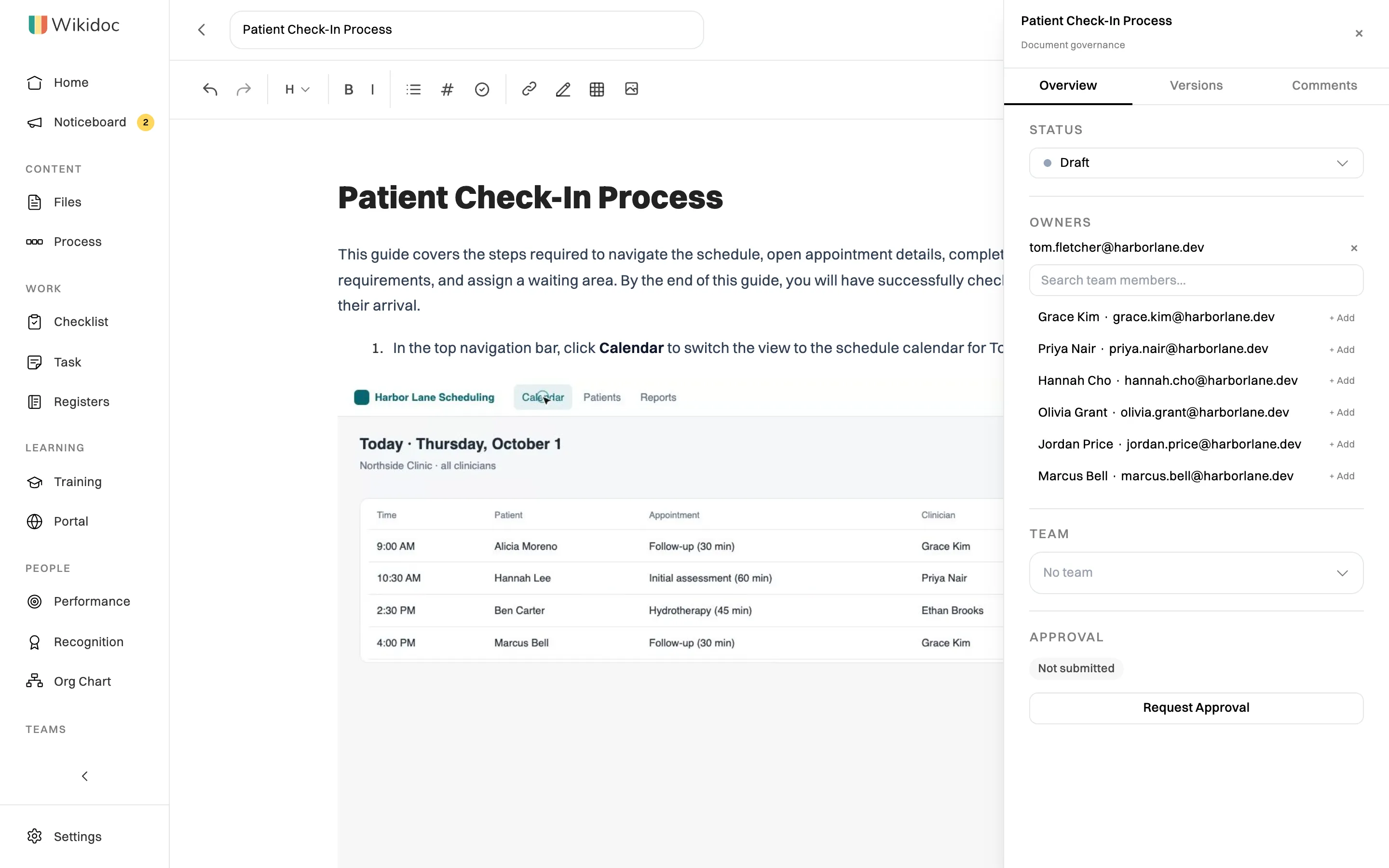
Each SOP has owners and a status, with version history on Pro and Team and an approval workflow on Team, so the team always works from the current, approved version. Turn the SOPs for a role into training modules, link them to steps on your process maps, and check the recurring work with checklists. The Free plan includes three AI-generated documents and ten from templates, and the Help Centre walks through creating a document and document governance.
Start free and write the SOP for the task you explain most often.
A standard operating procedure is a written set of steps for doing a routine task the same way every time. It tells anyone doing the task what to do, in what order, and what “done” looks like, so the result doesn’t depend on who does it or how long they’ve been in the job.
The main purpose of an SOP is consistency: the task is done correctly, the same way, whoever does it. That consistency also makes training faster, reduces mistakes, makes it possible to delegate work and gives auditors and regulators evidence that the work is controlled.
Most SOPs have a header with the title, version and owner, then a purpose, scope, roles and responsibilities, definitions, equipment, numbered steps, safety cautions, the records to keep, related documents and a revision history. Short SOPs can combine some of these, but the steps, owner and version should always be there.
A policy states a rule or commitment and why it exists, such as “refunds are given within 30 days”. An SOP explains how to carry out the work that follows from the policy, step by step, such as how to process a refund. Policies change rarely; SOPs change whenever the way the work is done changes.
As short as it can be while still being complete. Many good SOPs fit on one or two pages, with 5 to 15 steps. If a procedure needs much more, split it into several SOPs, or use a process map for the overview and SOPs for the detailed steps.


