.png)

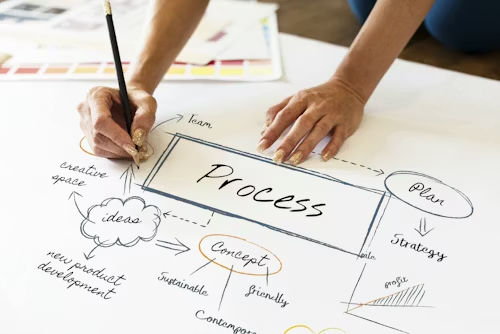
A Standard Operating Procedure (SOP) is a documented, step-by-step set of instructions for performing a routine or essential task. The goal of an SOP is to ensure tasks are done correctly and consistently every time. By following SOPs, organisations can maintain quality and safety standards, reduce errors, and comply with regulations. In essence, SOPs capture organisational knowledge: they define who does what, how, and when.
Well-crafted SOPs keep all team members on the same page. They provide clarity on roles and responsibilities, list necessary equipment or materials, and describe each procedure step clearly. When written from the user’s perspective, SOPs become practical guides that simplify training and onboarding. According to industry experts, effective SOPs “provide the processes needed for an organisation to succeed” by reducing errors and increasing efficiency. In short, an SOP is more than a document, it is a roadmap that embeds best practices and compliance into daily operations.
Standardised procedures benefit virtually every industry because they offer consistency, safety, and clarity. No matter the business, clear SOPs mean that even new employees can follow established practices. This consistency improves quality and productivity: for example, when every technician follows the same calibration steps on a machine, the output remains reliable. SOPs also speed up training and reduce human error, since staff don’t have to “re-invent the wheel” each time.
Furthermore, SOPs create a shared knowledge base. By documenting how work gets done, they capture institutional memory and prevent critical know-how from walking out the door when an employee leaves. This helps maintain performance over time and across teams. From a compliance standpoint, SOPs signal discipline: they “provide guidelines for resolving issues and overcoming obstacles” and help ensure that processes meet industry standards. In many sectors, writing things down is simply good business.
In practice, SOPs appear in countless scenarios. A restaurant might have an SOP for cleaning kitchen equipment; a hospital has SOPs for sanitising instruments or administering medication; a manufacturer uses SOPs for machine start-up and shutdown. Even office environments benefit – think of SOPs for data backups or security procedures. Ultimately, any activity that benefits from standardisation and quality control can leverage an SOP.
In highly regulated industries, formal SOPs are often a legal or compliance requirement. For example, in pharmaceuticals and biotech, government agencies mandate extensive SOPs. U.S. FDA regulations (21 CFR Part 211) explicitly require written SOPs for virtually every aspect of drug manufacturing – from sanitation and equipment maintenance to batch record-keeping and laboratory testing. Similarly, the EU’s Good Manufacturing Practice (GMP) guidelines list dozens of procedural documentation requirements. In practice, companies in food & beverage, medical devices, and chemical manufacturing must have SOPs to comply with health and safety laws.
Other industries with documented-SOP obligations include aerospace and aviation (for safety-critical procedures), automotive (quality control processes), nuclear energy, and healthcare (clinical protocols and patient safety procedures). Even sectors like hospitality and finance may have internal or audit-driven SOP standards. In short, any field where consistent quality, safety, or legal compliance is paramount will lean heavily on SOPs. In those industries, failing to document standard procedures is not just risky – it can be unlawful.
For example, the pharmaceutical sector’s reliance on SOPs is underscored by the U.S. FDA: “Written procedures (SOPs) are required for many records” under Part 211, and new regulations make them a routine part of drug production. This principle extends to other regulated fields: auditors and regulators look for clear SOPs as evidence of proper control. Thus, SOPs are often not optional add-ons but necessary documentation mandated by law and industry standards.
Despite their importance, SOPs face several practical challenges:
In summary, SOPs often fail not in concept but in execution. Common pitfalls include excessive effort to produce them, lack of maintenance, and cultural issues with usage. Addressing these challenges is critical to ensure that procedures actually drive performance improvements.
The most time-consuming aspect of SOPs is the initial creation and ongoing updating. This is precisely where automation can help. New AI-powered documentation tools (like our Wikidoc platform) dramatically reduce effort. Instead of manually writing every step, teams can record their workflow (video capture) and let AI generate polished instructions with visuals. In practice, what used to take hours of producing can be done in minutes. Using such a tool solves the “painfully manual” problem by capturing tasks as you do them, removing nearly all drudgery from SOP creation. The result is an up-to-date SOP without the usual headache.
More broadly, AI-based solutions streamline SOP updates as well. Modern documentation platforms use algorithms to flag changes in applications or processes and suggest edits to existing procedures. They can auto-version documents, send reminders for reviews, or even translate content across languages. In effect, they keep SOPs current with minimal human intervention. (Industry guides note that “modern [SOP] software…streamlines creation, keeps documentation up-to-date, and makes information easily accessible”.) In short, AI doesn’t just speed up writing new SOPs, it also keeps them living and relevant with far less manual upkeep.
To address outdated SOPs, organisations should establish a clear maintenance cycle. Each SOP should have an assigned owner responsible for periodic review (often 1–2 years) and any revision after process changes. Reliable maintenance programs recommend walking the procedure with frontline users to spot gaps. By involving people who do the work every day, updates can catch “where the real process deviates from the written one”. Assigning ownership also means SOPs are not forgotten; they become living documents rather than museum pieces.
To improve adoption, SOPs should be written in clear, concise language (active voice, step-by-step) and include visuals where possible. Bullet lists, annotated diagrams and photos, or even short video snippets can make procedures easier to follow. For example, the reliability article recommends embedding diagrams and QR-linked videos in SOPs to reduce ambiguity. This format is far more engaging than text-heavy instructions and helps ensure everyone can follow along correctly.
Version control is solved by centralising SOPs in an accessible digital system. Rather than paper binders, use a cloud-based document control platform (or Wikidoc itself) where the latest SOPs live. Every update is time-stamped and tracked. Giving all team members access to one repository means no one is using stale versions. Even better, embed SOP retrieval into daily tools. For example, some modern SOP platforms offer search or browser extensions that surface the relevant procedure when an employee needs it, making following SOPs part of the workflow rather than an extra task. This approach, treating SOPs as dynamic knowledge assets in your software ecosystem, closes the loop on usability and adoption.
Finally, SOPs should not be created in isolation by managers. Involving the people who actually perform the tasks ensures relevance. Techniques like peer-review of drafts, or “training sessions” where new SOPs are demonstrated, help build ownership. An effective practice is to test employees on the SOP (quizzes or on-floor observation) to confirm comprehension. This not only catches any confusing wording but also reinforces the importance of following the documented steps.
In summary, solving SOP challenges means combining process (review schedules, ownership, collaboration) with smart tools. AI-powered documentation handles the grunt work of writing and updating, while strong SOP governance ensures accuracy and compliance. Together, these steps turn SOPs from a painful chore into a smooth part of operations.
While formats vary by organisation, most effective SOPs share common components. A typical SOP template includes:
These elements align with best practices. As one FDA compliance guide advises, a good SOP will have a header, purpose, scope, references, definitions, roles/responsibilities, procedure steps, appendices, revision history, and approval signatures. Using such a template ensures consistency across documents and makes it easy for anyone to find critical information (such as who approved the latest version).
When writing the steps, keep language active and direct. Use bullets or numbering for each action. Avoid vague terms like “periodically” or “as needed” in steps – if possible, replace them with precise conditions. Remember, the end-user of the SOP should be able to pick it up and perform the task without guesswork.
Using a standard template also helps when converting processes into different formats (e.g. linking to training videos or checklists). Many modern SOP platforms offer built-in templates so you can focus on content, not formatting. Having a solid template saves time and helps prevent omissions - which, in turn, reduces compliance risks and confusion.
Artificial Intelligence is transforming how organisations create, update, and use SOPs. Today’s AI tools automate a large part of process documentation. For example, AI-powered software can take a screen recording of a task and instantly generate a step-by-step SOP, complete with screenshots and descriptions. This turns what was once a full-day effort into a task that takes minutes.
Beyond creation, AI helps keep SOPs in sync with reality. Machine learning algorithms can detect when a workflow has changed (e.g. a button moved or a new step added) and flag outdated instructions. Some AI systems analyse user activity to suggest edits or highlight processes that lack coverage. By continually learning from how employees actually do tasks, AI ensures that SOPs stay current without the guesswork.
AI also improves accessibility. Natural language search and assistants can let employees find the right SOP by simply asking a question in plain language. Voice interfaces or embedded chatbots can narrate steps or display visuals on demand. In a sense, AI blurs the line between documentation and user experience. Instead of digging for a paper manual, a technician might have the relevant SOP “pop up” contextually through an AI-driven system.
Industry experts highlight this shift. A recent review notes that AI-powered SOP tools save “significant time” and keep documentation “up-to-date” and easily accessible. In practical terms, AI turns the SOP from a static report into a living knowledge resource. This means teams spend less time writing and hunting for procedures, and more time actually following them safely.
Of course, human oversight remains important. AI tools generate drafts that should be reviewed by process owners. But by accelerating the mundane parts of documentation, AI frees up experts to focus on refining content and training staff.
With AI as a partner, organisations should treat SOPs as dynamic digital assets rather than static manuals. The goal is to embed SOPs in the workflow, not hide them in binders. Modern approaches suggest integrating SOP systems directly with the tools and platforms employees use every day. For instance, some SOP software can automatically present the relevant procedure on an employee’s screen based on the task at hand. This makes following the SOP a natural part of the workday.
The culture around SOPs must also evolve. Instead of seeing them as chore compliance tasks, companies should emphasise that SOPs (and their AI-enhanced versions) are tools for empowerment and safety. Encourage feedback loops: as new challenges arise on the floor, update the SOP promptly. Use analytics from the SOP platform to see which procedures get used often (or ignored), and refine them accordingly. Automation can track whether employees truly follow steps (e.g. requiring them to click through each stage), so that training needs are spotted early.
Organisations should leverage AI to personalise SOP delivery. For example, new hires might be given multimedia SOPs (text + video) to accelerate learning, while veterans might receive quick reference guides with decision trees. Translating SOPs into different languages automatically can help global teams stay aligned. In short, AI lets you tailor SOPs to audience and context, which was impractical with static documents.
Finally, even with AI, human roles remain crucial. Assigning SOP ownership – a named person responsible for each procedure – ensures accountability. Require final approvals on AI-generated SOP drafts. And maintain the habit of regular audit: AI can help track changes, but organisations should still periodically validate that procedures match reality. In the digital era, treating SOPs as “living” entities means using technology to keep them current and then using human insight to validate and improve them.
Standard Operating Procedures are a cornerstone of organisational efficiency, quality, and compliance. By codifying the “how” of daily operations, SOPs reduce mistakes and training time, and they anchor processes to best practices. However, the traditional way of handling SOPs - as static manuals updated by hand - is fraught with challenges: it is laborious, error-prone, and often leads to outdated guidance.
The good news is that we now have the tools to overcome these hurdles. AI-driven documentation platforms (like Wikidoc) can slash the time needed to create and update SOPs by automatically generating content from real workflows. At the same time, digital SOP systems ensure procedures stay current, searchable, and integrated into daily work. By adopting these modern approaches, organisations can turn SOPs from a painful compliance task into a living asset that truly supports the team.
In practice, that means automating as much as possible, writing clearly, and reviewing regularly. It means giving employees easy access to SOPs and making them a natural part of the workflow. With those steps, an organisation can reap all the benefits of consistency and safety that SOPs promise - without the old frustration. In the age of AI, a well-implemented SOP programme is no longer just a legal checkbox, but a strategic advantage.